



Amid Conflict Numerous Opportunities Arise in Stocks



A combination of geopolitical tension, technological disruption fears, and financial market stress has created one of the most opportunity-rich environments I have seen in some time. The conflict involving Iran, growing concerns about AI potentially disrupting large segments of the software industry, and several high-profile blowups in the private credit space have rattled sentiment across markets. Yet periods like this, when uncertainty dominates headlines, often create some of the most attractive entry points for disciplined investors.
Importantly, the broader macro backdrop remains constructive. Global economic growth continues at a solid pace, productivity gains are beginning to materialize from technological adoption, and enormous capital expenditures tied to the AI infrastructure buildout are flowing through the global economy. These forces collectively provide a powerful foundation for continued economic expansion.
The primary risk to that outlook at the moment is the escalating situation in Iran. Rising tensions in the region have pushed oil prices sharply higher and introduced the possibility of inflationary pressure if the conflict were to persist or intensify. A prolonged disruption to global energy markets could weigh on economic activity and complicate the outlook for policymakers. That said, as I will outline below, I currently assign relatively low odds to a drawn-out conflict and view some form of resolution in the near term as the more likely outcome.
Despite the geopolitical noise, the equity market itself remains remarkably resilient. Major indexes are still trading only a few percentage points below their record highs. At the same time, many of the market’s largest leaders remain well off their peaks. This dynamic reflects a broadening of market participation, an encouraging development that stands in sharp contrast to the persistent warnings over the past year about excessive index concentration. Rather than signaling weakness, the expansion of leadership across sectors is often characteristic of durable bull markets.
In recent pieces I highlighted opportunities in the Magnificent Seven and the software sector, while earlier coverage focused on energy and gold, both of which have performed exceptionally well. I continue to believe those themes remain intact, though after such strong momentum they may begin to consolidate, particularly if capital rotates back into sectors that now appear discounted.
Today I want to focus on several additional opportunities emerging across technology and financials, including Expedia (EXPE), Nvidia (NVDA), Fair Isaac (FICO), Broadcom (AVGO), Apollo Global Management (APO) and Dell Technologies (DELL).
Interestingly, today’s market action may already be reflecting that view. Overnight, Nasdaq 100 e-mini futures were down more than 2%, yet by the open the market had staged a powerful reversal, pointing to the type of sharp, potentially capitulatory price action that often accompanies intermediate-term bottoms.
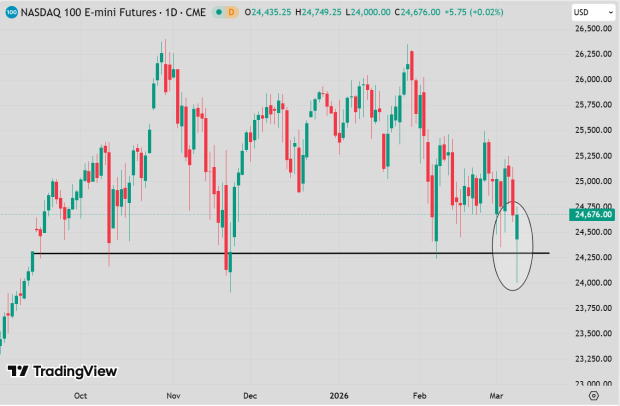
Image Source: TradingView
Why the Iran Conflict May Be Shorter Than Markets Fear
Despite the alarming headlines, several structural factors suggest the Iran conflict may be less likely to evolve into a prolonged regional war than many investors fear. According to my research, Iran has already suffered significant degradation of its military capabilities. Much of its missile-launch infrastructure has reportedly been destroyed, and the country has already used a large portion of its ballistic missile inventory while facing a relatively high failure rate. Just as importantly, the infrastructure needed to produce new missiles was damaged in prior strikes, meaning Iran cannot easily replenish its arsenal. These constraints limit Iran’s ability to sustain a long-duration conflict.
Iran also appears to have miscalculated strategically and diplomatically. By launching missiles at several Gulf states, Tehran inadvertently pushed governments that had previously tried to remain neutral closer to the US and Israel. Rather than destabilizing the region politically, the attacks created a rally-around-the-flag effect among Gulf monarchies and provided them political justification to support defensive and potentially offensive actions. Combined with the weakening of Iran’s proxy networks across the region, this further reduces the likelihood that Iran can maintain a prolonged confrontation.
Perhaps most importantly, the expected endgame appears to point toward a negotiated off-ramp rather than regime change. It seems to me that the US and Israel may spend several weeks degrading Iran’s military infrastructure before reopening diplomatic channels. Notably, President Trump’s public position has remained somewhat vague, particularly around what constitutes “unconditional surrender,” leaving room for a resolution that stops short of toppling the regime. In practice, this could mean Iran accepts new military constraints while the existing government remains in place. While a worst-case scenario cannot be ruled out, assessments suggest the probability of a prolonged regional war remains relatively low.
Something also worth noting is the price action in crude oil futures. Similar to what we are seeing in the Nasdaq and broader equity indexes, oil has experienced a sharp reversal that may signal a form of capitulation. Overnight, WTI crude futures briefly surged to $119.48, but prices have since reversed sharply, falling nearly $25 from those highs. While it is impossible to know whether that spike ultimately marks the peak in oil prices, this type of rapid surge followed by an equally aggressive pullback often occurs near turning points and increases the probability that the market may have already seen the worst of the panic-driven move.
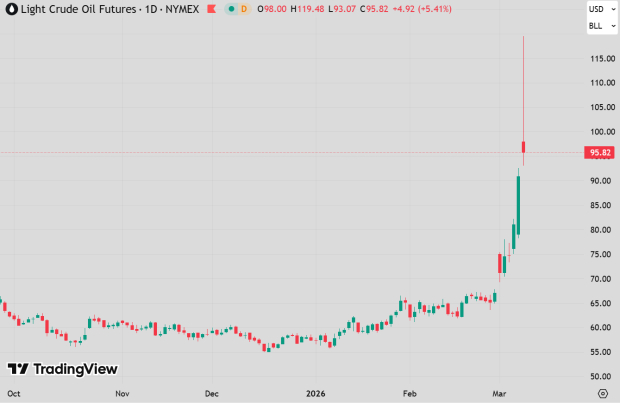
Image Source: TradingView
Financial Sector Opportunities: Fair Isaac and Apollo Global Stocks
I have not focused much on the recent drama in the private credit market in my commentary, but it has become a major topic of discussion across the credit and debt industry. Private credit has expanded at an extraordinary pace, growing from roughly $500 billion in assets under management in 2020 to around $2 trillion today, and was virtually nonexistent as an institutional asset class just a decade ago.
Apollo Global Management has emerged as one of the clear leaders in this rapidly expanding market. The boom has been extremely lucrative for firms operating in the space, though the speed of growth has also raised concerns that some lenders may have become overly aggressive with underwriting standards. Blue Owl Capital has been the primary company in the headlines amid these concerns, fueling broader fears of stress within the private credit ecosystem.
Much of the commentary surrounding the issue has drawn comparisons to the 2008 financial crisis, though that characterization appears exaggerated. Leverage levels across the system are considerably lower, and the risks appear far more contained. Nevertheless, the concerns have pressured stocks across the alternative asset management space, including Apollo.
That pullback has created a potentially attractive entry point. Apollo Global Management currently trades at just 11.8x forward earnings, near one of its most compelling valuations in years. At the same time, earnings are projected to grow 14.3% annually over the next three to five years, while revenue is expected to climb in the high teens this year and next. Importantly, Apollo’s business is also highly diversified across asset management, insurance, and private markets, meaning its earnings power extends well beyond private credit alone.
Fair Isaac, meanwhile, has been caught up in a completely different selloff. Rather than credit market concerns, the stock has been pressured by the broader correction in software stocks, as well as lingering controversy surrounding price increases implemented more than a year ago. Despite that noise, the company’s underlying business continues to perform exceptionally well.
Shares currently trade at 35.2x forward earnings, which is not inexpensive on an absolute basis but looks more reasonable relative to the company’s historical valuation. Over the past decade, Fair Isaac has traded at a median multiple of roughly 50x earnings, reflecting the company’s powerful competitive moat and dominant position in credit scoring. That competitive advantage remains firmly intact, and analysts expect earnings to grow nearly 28.6% annually over the long term, suggesting the company’s premium valuation may continue to be justified.
Tech Stock Opportunities Multiply: NVDA, AVGO, EXPE and DELL
Concerns about overvalued technology stocks have dominated market conversations for much of the past year. Yet in many cases, the data no longer supports that narrative. After a period of sharp corrections and consolidations, several major technology companies are now trading at far more reasonable valuations while their underlying businesses continue to grow at impressive rates.
A number of tech leaders now stand out as particularly compelling opportunities, including Nvidia, Broadcom, Dell Technologies, and Expedia.
Nvidia, which carries a Zacks Rank #2 (Buy), remains the clear leader in AI infrastructure. Despite its dominant position, the stock now trades at roughly 22.7x forward earnings, a modest multiple for a company expected to deliver long-term EPS growth of about 39% annually. Revenue is projected to surge 59% this year and another 27% next year, reflecting continued explosive demand for AI compute. Nvidia has also expanded its reach by investing in numerous AI startups, giving the company exposure across AI ecosystem.
Broadcom offers many of the same structural growth catalysts tied to AI infrastructure and data center expansion. Shares currently trade at around 31.9x forward earnings, while analysts expect earnings to grow roughly 48.6% annually over the next three to five years. Revenue growth is projected to remain exceptionally strong as well, with sales expected to rise 53% this year and 45% next year, remarkable growth for a company of Broadcom’s scale.
Dell Technologies represents a different type of opportunity within the AI trade. The company was an early beneficiary of the surge in demand for AI servers and data center hardware, and the stock has spent the past couple of years consolidating those gains. Today, Dell trades at a very reasonable 11.5x forward earnings, while analysts expect earnings to grow about 18% annually over the next three to five years. With its valuation compressed and demand for AI infrastructure continuing to expand, the stock appears well positioned for a potential breakout to new highs.
Finally, Expedia stands out as a true bargain within the broader technology sector. Shares currently trade at roughly 13x forward earnings, while analysts expect EPS to grow nearly 20% annually over the long term. In addition to its strong portfolio of consumer travel brands, Expedia has been building a rapidly expanding B2B travel platform, which allows partners to access its inventory and booking technology. That segment has become an increasingly important driver of growth having grown 24% in the past year.
Finding Opportunity in Uncertain Markets
Periods of uncertainty often create the most compelling investment opportunities. While geopolitical tensions and sector-specific fears have unsettled markets in the short term, the broader economic backdrop remains constructive and many high-quality companies are now trading at far more attractive valuations than they were just a year ago.
For disciplined investors willing to look through the current noise, opportunities are emerging across several sectors. If the macro environment remains stable and current fears begin to fade, these names could be well positioned to participate in the next leg of the bull market.
5 Stocks Set to Double
Each was handpicked by a Zacks expert as the #1 favorite stock to gain +100% or more in the coming year. While not all picks can be winners, previous recommendations have soared +112%, +171%, +209% and +232%.
Most of the stocks in this report are flying under Wall Street radar, which provides a great opportunity to get in on the ground floor.
Today, See These 5 Potential Home Runs >>Want the latest recommendations from Zacks Investment Research? Today, you can download 7 Best Stocks for the Next 30 Days. Click to get this free report
Dell Technologies Inc. (DELL): Free Stock Analysis Report
NVIDIA Corporation (NVDA): Free Stock Analysis Report
Expedia Group, Inc. (EXPE): Free Stock Analysis Report
Broadcom Inc. (AVGO): Free Stock Analysis Report
Apollo Global Management Inc. (APO): Free Stock Analysis Report
Fair Isaac Corporation (FICO): Free Stock Analysis Report
This article originally published on Zacks Investment Research (zacks.com).
Source Zacks-com


