



Micron vs. Marvell: Which Pullback Is a Buy?


The stock market’s advance from late March through early July produced several major winners, but few were more impressive than Micron Technology (MU) and Marvell Technology (MRVL). Both stocks more than tripled from their spring lows as investors rushed into companies positioned at critical points across the AI infrastructure buildout.
Micron benefited from surging demand for high-bandwidth memory, a critical component for AI inference, the fastest growing requirement for LLMs. Memory has historically been one of the most commoditized and cyclical areas of the semiconductor industry. But as demand began overwhelming available supply, Micron found itself controlling one of the scarcest resources in the AI ecosystem. Pricing power followed, earnings estimates soared and the stock responded accordingly.
Marvell’s rally was similarly dramatic. The company was already benefiting from rapid growth across custom silicon, interconnects, switching and optical networking, which is the plumbing that allows increasingly large AI data centers to function. Then Nvidia CEO Jensen Huang added fuel to the move by identifying Marvell as a potential future trillion-dollar company.
But after extraordinary three-month runs, both stocks have reversed sharply. Micron is now more than 20% below its recent high, while Marvell has fallen more than 35%.
So, is it time to buy the pullback?
Not quite. Micron is approaching a potentially attractive setup, but Marvell likely needs more time to stabilize.
The AI Sentiment Pendulum Swings Again
I do not believe the AI boom is ending. However, it seems the narrative pendulum had swung too far toward exuberance, and periods of extreme optimism typically require a meaningful reset before the next sustainable advance can begin.
We have seen this pattern several times throughout the AI boom. Concerns about capital spending, cheaper Chinese models, declining inference costs, competitive threats and uncertain returns on investment have repeatedly triggered sharp pullbacks.
Each concern has some merit. The largest technology companies are spending unprecedented amounts on AI infrastructure, while the ultimate economics of many AI services remain uncertain. But similar doubts have emerged before, and the broader semiconductor cycle has consistently resumed its advance after expectations and positioning cooled.
The process is never as clean as a theoretical model. Sentiment moves between enthusiasm and skepticism, producing irregular peaks and drawdowns around a longer-term trend. So far, however, each major cycle within the AI trade has ultimately resolved higher.

Image Source: Zacks Investment Research
Given the size of the recent declines and the sharp reversal in sentiment, I suspect the semiconductor correction is now closer to its end than its beginning. That does not mean the final low is already in. The group could still experience another leg lower, but much of the excess enthusiasm is leaving, and the risk-reward profile is becoming more constructive as expectations reset.
That does not mean every pullback should be purchased immediately. The underlying trend can remain intact while individual stocks decline further, consolidate for months or permanently lose leadership. Investors still need to distinguish between a durable business inflection and a stock that simply ran too far ahead of itself.
MU and MRVL Were Fundamental Rallies, Not Pure Speculation
It is important to recognize that the advances in Micron and Marvell were supported by genuine business growth.
I highlighted both companies well before their most recent rallies. Last summer, I discussed Marvell’s compelling long-term setup following a disappointing earnings reaction in this interview. I also identified Micron as a non-consensus AI winner here near the beginning of what became an extraordinary advance.
The fundamentals subsequently exceeded even optimistic expectations.
That separates the current situation from a purely speculative bubble. Investors were not merely bidding up unprofitable companies based on distant promises. Micron and Marvell produced substantial revenue growth, rapidly improving earnings and exposure to areas of the AI supply chain where demand remains strong.
Still, even fundamentally justified rallies can overshoot. After moves of this magnitude, more air may need to come out before either stock is ready for its next sustained leg higher.
Micron’s Unbelievable Earnings Growth
Micron’s recent financial performance has been exceptional and helps explain why the stock gained so much so quickly.
In fiscal Q3 2026, ended May 28, Micron earned $25.11 per share on a non-GAAP basis, up more than 1,200% from $1.91 one year earlier. Revenue increased 346%, climbing from $9.30 billion to $41.46 billion.

Image Source: Zacks Investment Research
The company’s outlook suggested that the acceleration was not finished. Management guided fiscal Q4 revenue to approximately $50 billion, with non-GAAP earnings approaching $31 per share. Both would represent records by enormous margins.
Micron’s earnings revisions have been equally remarkable. According to Goldman Sachs, the company accounted for roughly 51% of all S&P 500 earnings-per-share revisions during the recent period it measured. That is an astounding contribution from one company and demonstrates how aggressively expectations have been repriced around memory demand.
But that concentration also creates risk.
Micron is no longer an overlooked AI beneficiary. Investors now broadly understand the high-bandwidth-memory shortage, the company’s pricing power and the scale of its earnings growth. Future gains will increasingly depend on whether Micron can continue exceeding already elevated expectations.
The company also remains exposed to the memory cycle. AI may have created something closer to a silicon super-cycle, but supply eventually responds to high prices. Customers can adjust spending, competitors can expand production and exceptionally strong margins can attract additional capacity.
Technically, Micron is now testing an important support area. The stock has not yet broken its broader uptrend, but a decisive move below that level would weaken the setup and suggest that the reset has further to run.
For investors interested in buying the pullback, Micron is the more compelling of the two stocks. However, I would still wait for evidence that support is holding and volatility is beginning to decline rather than trying to predict the exact bottom.

Image Source: TradingView
Jensen Huang’s Trillion-Dollar Call on Marvell
Marvell has also delivered unusually strong growth, although its underlying inflection began well before the stock’s most recent surge.
For a time, that improvement was hidden beneath weak headline results. Total revenue barely increased from $5.5 billion in fiscal 2024 to $5.77 billion in fiscal 2025 as deep downturns in Marvell’s legacy carrier and enterprise businesses offset rapid data-center growth.
One layer beneath the headline numbers, however, the transformation was already underway.
Data-center revenue grew 88% in fiscal 2025 and represented approximately 75% of the company’s business by year-end, up from roughly 50%. Custom AI silicon entered volume production while Marvell’s electro-optics business continued supplying the connectivity required to move data across increasingly complex AI systems.
Once the weakness in the legacy businesses began to ease, the underlying growth became visible in the consolidated results.
Fiscal 2026 revenue reached a record $8.2 billion, representing growth of 42%, while data-center revenue surpassed $6 billion. Non-GAAP earnings rose 81% to $2.84 per share, and fiscal Q1 2027 revenue increased another 28%.

Image Source: Zacks Investment Research
Those results help explain why Marvell has become a prominent AI infrastructure companies. The business spans several important areas, including custom accelerators, optical connectivity, switching and data-center interconnects.
But the valuation leaves little room for disappointment.
Marvell trades at more than 50x forward earnings, although long-term earnings growth forecasts are also near 50%. That combination can support a premium multiple, but only while growth remains exceptional and execution consistently exceeds expectations.
Marvell may eventually become a trillion-dollar company, but getting there would require years of extraordinary compounding. Even at an elevated multiple, a $1 trillion valuation would imply approximately $20 billion in annual profit. That is an enormous leap from the company’s current earnings base.
For that reason, I would not treat the trillion-dollar prediction as a near-term investment thesis. It is better understood as an expression of Marvell’s strategic importance within the AI infrastructure ecosystem.
The immediate technical picture is less encouraging. Momentum has shifted decisively lower, volatility remains elevated and the stock has not yet established a clear support level. Rather than buying simply because Marvell is 35% below its high, I would wait for visible base-building, tighter trading ranges and evidence that sellers are becoming exhausted.
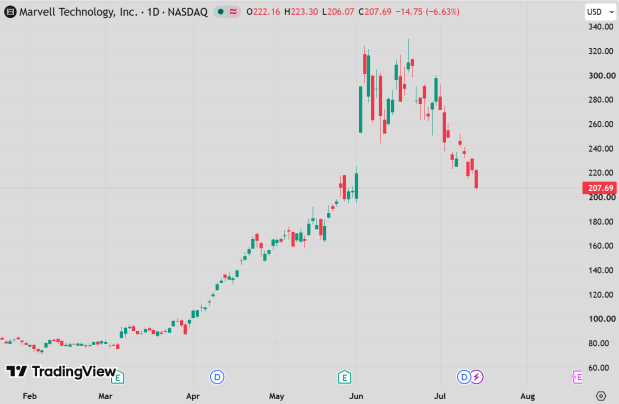
Image Source: TradingView
Micron Is Closer to a Buy Than Marvell
Both stocks remain tied to powerful long-term trends, but the risks are different.
Micron’s primary risk is the durability of the memory cycle. Investors must determine how long high-bandwidth-memory demand can outpace supply and whether exceptional pricing and margins can persist as production expands.
Marvell’s primary risks are valuation and execution. The company must continue converting its strong positioning in custom silicon and connectivity into earnings growth sufficient to justify a premium multiple.
Micron currently offers the more attractive setup because its earnings momentum is stronger and the stock is testing a clearly defined technical level. Marvell has experienced a more serious momentum breakdown and likely needs a longer period of stabilization.
That does not mean Micron should be purchased indiscriminately. A break below support could create another meaningful leg lower, particularly if broader semiconductor sentiment continues deteriorating.
For now, I would classify Micron as a stock to watch closely near support. Marvell remains a stock to wait on until its volatility declines and a credible base begins to form.
How Investors Can Approach MU and MRVL
The recent declines in Micron and Marvell look more like sentiment resets than evidence that the AI infrastructure boom is breaking. Their rallies were supported by legitimate business growth, extraordinary earnings momentum and exposure to some of the most strategically important parts of the semiconductor industry.
But strong businesses do not automatically become attractive stocks at every price.
The narrative pendulum is now swinging away from exuberance and back toward skepticism. That process could continue for several weeks or months as investors question AI spending, future returns and whether the industry has expanded capacity too aggressively.
Micron is closer to an actionable entry, but investors should first look for support to hold and trading conditions to stabilize. Marvell carries a more demanding valuation and has suffered a more decisive technical breakdown, making patience especially important.
The larger AI opportunity likely remains intact. But after rallies of this magnitude, investors do not need to rush. MU is a watch near support, while MRVL remains a wait. A durable bottom could eventually create attractive opportunities in both, but neither stock has fully completed its reset.
Radical New Technology Could Hand Investors Huge Gains
Quantum Computing is the next technological revolution, and it could be even more advanced than AI.
While some believed the technology was years away, it is already present and moving fast. Large hyperscalers, such as Microsoft, Google, Amazon, Oracle, and even Meta and Tesla, are scrambling to integrate quantum computing into their infrastructure.
Senior Stock Strategist Kevin Cook reveals 7 carefully selected stocks poised to dominate the quantum computing landscape in his report, Beyond AI: The Quantum Leap in Computing Power.
Kevin was among the early experts who recognized NVIDIA's enormous potential back in 2016. Now, he has keyed in on what could be "the next big thing" in quantum computing supremacy. Today, you have a rare chance to position your portfolio at the forefront of this opportunity.
See Top Quantum Stocks Now >>Want the latest recommendations from Zacks Investment Research? Today, you can download 7 Best Stocks for the Next 30 Days. Click to get this free report
Micron Technology, Inc. (MU): Free Stock Analysis Report
Marvell Technology, Inc. (MRVL): Free Stock Analysis Report
This article originally published on Zacks Investment Research (zacks.com).
Source Zacks-com


