



Wayfair, Carvana Gain Share in Difficult eCommerce Industry



While ecommerce continues to take share from traditional retail, the pace has moderated. Additionally, geopolitics is a major challenge for ecommerce players at the moment given the wars, tariffs and tensions between nations today that are disrupting supply chains, increasing costs and reducing efficiencies. This creates a highly competitive environment where growth comes mainly from price competition and share gains.
Our picks Wayfair W and Carvana CVNA are doing precisely that. Wayfair offers a huge range of home improvement products along with nationwide infrastructure and logistics in an attractive format that allows it to record significant share gains. It has trimmed its cost structure, so its surging revenues are falling through to the bottom line. Carvana is seeing even stronger share gains, as it offers a superior online buying experience in a used-car market that is still largely brick-and-mortar.
Both companies are sensitive to interest rate movements however, therefore the latest FOMC deliberations are not supportive. We believe they will continue to grow regardless because of their unique capabilities and market positioning.
The convenience of online shopping (particularly through mobile devices) remains the top reason for ecommerce volumes, along with the merging of physical and digital channels. Gen-Z is the biggest driver, which is, increasingly, the more relevant demographic.
Many of these buyers have grown up on the Internet and are accustomed to a high level of digitization. They are also likely to hang out on popular social media platforms, allowing themselves to be influenced by the latest trends there. This is driving an entirely different perspective on the ecommerce space, one that revolves around digital influencers and appears to be expanding with more advanced technology such as AR/VR, social commerce and generative AI.
About the Industry
Internet - Commerce refers to all economic activity (B2B, B2C, C2C, DTC) through websites, mobile apps, online marketplaces. and social commerce platforms. It therefore continues to evolve as the technologies driving it advance, whether on the consumer side or the platform provider side that increasingly includes a combination of chatbots, AI and social media, as well as payments and checkout systems, digital marketing, logistics and fulfillment, cross-border trade, and customer data/analytics tools.
Differentiation comes from better technology for improved showcasing, range, easier navigation and payment, speedier delivery and returns, brand building, comparison shopping, loyalty, etc. as well as good customer service and more (and free) shipping options, which generally tip the scales in favor of larger players.
Current Trends Driving the Internet-Commerce Industry
- ·Macroeconomics and geopolitics do not favor the industry right now. The macroeconomic environment is creating a more cautious and cost-sensitive backdrop for the industry, shifting it from a high-growth phase to one focused on efficiency and profitability. Elevated inflation has reduced consumers’ real purchasing power, leading to weaker discretionary spending and a greater focus on essentials, discounts and value-driven purchases. At the same time, still-high interest rates keep borrowing costs for both consumers and companies elevated, affecting both the production and consumption sides of the equation. Consumer confidence about the current labor market continues to soften and consumption is still being driven largely by inflation. As a result, there is continued pressure on conversion rates and basket sizes, while rising labor, logistics and warehousing costs continue to squeeze margins. As a result, companies are prioritizing cost control, automation and higher-margin revenue streams such as advertising and subscriptions to sustain profitability in a slower-growth environment. Geopolitics is simultaneously reshaping the industry by disrupting the global infrastructure that e-commerce depends on. Trade tensions, tariffs and regional conflicts are increasing the cost of goods and creating volatility in supply chains, leading to delays, stock shortages and higher shipping expenses. At the same time, the global trading system is becoming more fragmented, with companies shifting toward regional supply chains and “friendshoring” strategies to reduce risk, even at the cost of efficiency. Regulatory complexity is also rising.
- Competition is heating up. Ecommerce has raised the bar on what is an acceptable online marketplace. Today, it is one that offers low prices, fast or free shipping, hassle-free returns and a seamless omnichannel experience. Then again, because it is so easy to switch platforms, customer loyalty is hard to pin. Therefore, players increasingly find that mere online presence isn’t enough. They must strive for operational excellence, differentiated customer experiences, efficient logistics and disciplined capital allocation in order to stay in business.
- AI is shaping up to be one of the major enablers of ecommercebecause it transforms e-commerce from a generic marketplace into a highly customized, data-driven ecosystem that boosts both revenue growth and profitability. AI allows platforms to use customer data to optimize every step of the shopping experience. Companies like Amazon and Shopify leverage AI to deliver demand forecasting, targeted advertising, dynamic pricing and personalized product recommendations, significantly improving conversion rates and average order value. On the operational side, it helps optimize inventory and supply chains, reducing costs and enabling efficient deliveries. The latest development here is agentic commerce where LLM models like ChatGPT recommend products, compare features and complete the sale. Even if you’re unsure about what to buy, the statement of your general intention may be enough to complete a sale. As a result, customers get increasingly comfortable with the superior recommendations and personalization it offers. For example, Adobe estimates that traffic to retail sites from generative AI tools was up 693.4% year over year in the 2025 holiday season.
- The total retail experience between physical and digital continues to blur as most consumers blend their online and offline activities. This usually takes the forms of research online and buy in-store or buy online and pick up in-store. Physical stores are increasingly experience centers allowing the traditional touch and feel that many customers can’t do without. Some also prefer to walk out with their purchase. Therefore, a solid physical presence is undoubtedly a positive. Also, any experience that increases the speed of delivery/pickup is preferred. This may entail increased reliance on robots, self-driven delivery vehicles and drones that could ease bottlenecks and make deliveries smoother and cheaper.
- A leading trend is Gen-Z popularizing social commerce. Social commerce means the ability to discover, research and complete the purchase of products and experiences on a social media platform. Consumers shift from intent-based search to content-driven discovery while scrolling through short videos, influencer content or live streams on platforms like TikTok or Instagram.
Zacks Industry Rank Indicates Weakness
The Zacks Internet - Commerce industry is a rather large group within the broader Zacks Retail And Wholesale sector. It carries a Zacks Industry Rank of #180, which places it in the bottom 27% of 247 Zacks industries.
Our research shows that the top 50% of the Zacks-ranked industries outperforms the bottom 50% by a factor of more than 2 to 1. So the group’s Zacks Industry Rank, which is basically the average of the Zacks Rank of all the member stocks, indicates negative near-term prospects.
Ecommerce being in the bottom 50% of Zacks-ranked industries is the result of its relative performance versus others. What we’re seeing in the aggregate estimate revisions for 2026 is a more or less steady decline until March this year, followed by slight recovery. The 2027 estimate follows the same general trend but the recovery is somewhat sharper.
The past year has seen the aggregate earnings estimate for 2026 shrink 6.5%, while that for 2027 dropped 1.2% from 2025 actuals. The macroeconomic uncertainty, adverse geopolitics, the cautious tone around rate cuts, consumer thrift are contributing to softer spending and thus weaker estimates.
Before we present a few stocks that you may want to consider for your portfolio, let’s take a look at the industry’s recent stock-market performance and valuation picture.
Industry Returns Have Been Moderate
Over the past year, the Zacks Electronic - Commerce Industry has traded relatively close to the broader Retail and Wholesale sector although the S&P 500 pulled ahead in November.
The stocks in this industry have collectively gained 1.9% over the past year, compared to the 2.4% gain for the broader Zacks Retail and Wholesale Sector and the 24.2% gain for the S&P 500.
One-Year Price Performance
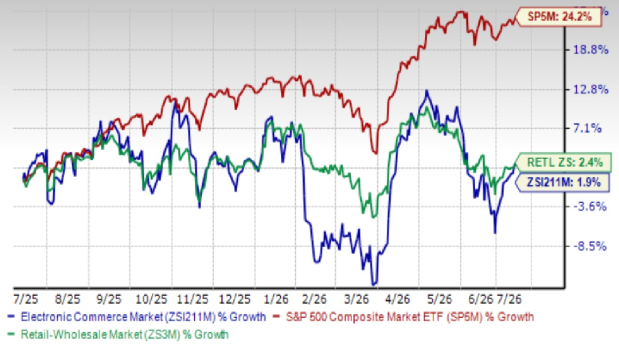
Image Source: Zacks Investment Research
Industry Somewhat Undervalued
Over the past year, the industry has mostly traded at a premium to the S&P 500 and a discount to the broader industry. Its current price-to-forward 12 months’ earnings (P/E) of 21.85X represents a premium of 2.9% to the S&P 500’s 21.24X, a 5.1% discount to the broader retail sector’s 22.97X and a 10.3% discount to its median value of 24.37X. The shares have traded in the range of 21.12X to 26.11X over the past year.
Forward 12 Month Price-to-Earnings (P/E) Ratio

Image Source: Zacks Investment Research
2 Stocks to Add to Your Portfolio
There is a significant variety of stocks in this industry in terms of lines of business, business model, location and so forth. This is also the reason that choosing stocks especially in the current environment can be tricky. We have used our proprietary ranking system to pick 2 stocks that appear attractive today.
Wayfair Inc. (W): Boston, MA-based Wayfair is an online retailer of a broad range of home improvement products across the furniture, décor, lighting, kitchenware, home improvement and outdoor categories. It has a large supplier network and proprietary logistics infrastructure supporting deliveries across the U.S.
Wayfair’s greatest strength is in the scale of its offerings (over 40 million products from more than 20,000 suppliers), which along with its investments in its logistics network and technology platform, enables it to deliver exceptional customer service and record share gains. Internally, the goal is to maximize EBITDA dollars while using excess cash to manage debt and buy back shares. The first-quarter EBITDA margin of 5.2% was the best in five years, so the plan appears to be on track.
A series of restructuring actions over the last few years has driven this improvement. During the pandemic the company had expanded operations, taking in extra hands to deal with the surging traffic. Between Aug 2022 and Mar 2025, it cut back over 5000 positions net of relocations, flattening the organizational structure to speed up decision making and reduce cost. AI adoption helped eliminate over 300 positions. It also exited German operations citing better prospects in the U.S., Canada, UK and Ireland. The result was a concentration of resources on initiatives that were likely to yield the highest returns.
With a leaner operating structure and stronger revenue growth outlook, Wayfair looks poised for continued growth. Recent results were mainly driven by share gains as the housing market to which it is tied remains sluggish. While it appears that interest rates will not come down further any time soon, this would be an additional catalyst, as it would bring mortgage rates down and large-scale home buying would return.
Analysts are clearly optimistic about Wayfair. The company certainly has a great track record of beating estimates, posting positive surprises in three of the last four quarters, at an average rate of 56.7%. For 2026, analysts expect 5.6% revenue growth and 11.9% earnings growth. For 2027, revenue and earnings growth are expected to be a respective 5.9% and 29.6%. In the last 30 days, analyst estimates for 2026 and 2027 have increased 12 cents (4.3%) and a penny (less than a percentage point).
The shares of this Zacks Rank #1 (Strong Buy) company’s shares are up 59.6% over the past year.
Price & Consensus: W
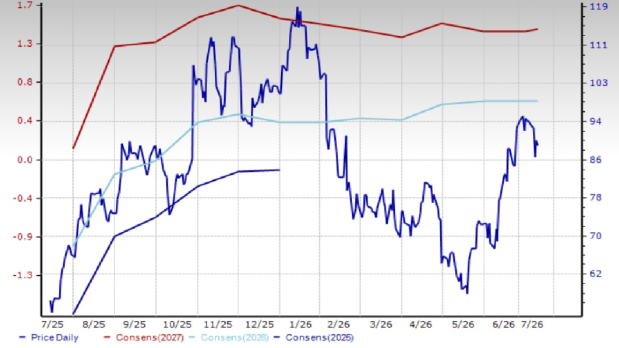
Image Source: Zacks Investment Research
Carvana Co. (CVNA): Tempe, AZ-based Carvana, through its website and mobile app, is America’s leading online marketplace for used cars. The entire transaction, from browsing inventory, financing, and purchasing vehicle protection products and insurance, is completed online with options for home delivery or pick up at a car vending machine. Following the acquisition of ADESA’s U.S. auction business, it also operates a nationwide logistics network, as well as vehicle auction, inspection and reconditioning facilities.
Carvana reported very strong quarterly results wherein unit volumes grew 40% (the sixth straight quarter of 40%+ growth) as the company continued to take share in a market that was essentially flat in the last quarter. The focus on its vertically integrated operating model and use of technology to improve customer experience helped it take share. While wholesale prices increased rapidly during the quarter, there was the typical lag in passing these on at retail, which compressed wholesale-to-retail spreads, hurting margins.
The company also stands to benefit from any improvement in the interest rate. Lower interest rates would bring more buyers into the market, and many replacement buyers would be likely to trade in their vehicles, adding to the used-car supply. Additionally, the used vehicle market in the U.S. is much larger than the new vehicle market, as used cars are much cheaper. As a result, affordability considerations are likely to drive a substantial portion of replacement demand toward used vehicles.
New vehicle production has largely recovered from the pandemic era disruption and new vehicle sales are expected to remain steady going forward. This, together with continued improvement in trade-in activity, should gradually replenish the supply of late-model used vehicles and create a healthier marketplace for both buyers and sellers.
Analysts are optimistic about double-digit revenue growth both this year and the next although the earnings growth rate is expected to decline a bit this year. Of course, actual growth rates may end up higher. Carvana certainly has a good track record of beating estimates: beating estimates in three of the last four quarters at an average rate of 71.6%.
For 2026, analysts expect 38.5% revenue growth and -6.5% earnings growth. For 2027, revenue and earnings growth are expected to be a respective 25.7% and 34.5%. In the last 60 days, analyst estimates for 2026 and 2027 have increased 5 cents (3.3%) and 4 cents (1.9%), respectively.
The shares of this Zacks Rank #2 company are down 5.2% over the past year.
Price & Consensus: CVNA

Image Source: Zacks Investment Research
Zacks' Research Chief Names "Stock Most Likely to Double"
Our team of experts has just released the 5 stocks with the greatest probability of gaining +100% or more in the coming months. Of those 5, Director of Research Sheraz Mian highlights the one stock set to climb highest.
This top pick is a little-known satellite-based communications firm. Space is projected to become a trillion dollar industry, and this company's customer base is growing fast. Analysts have forecasted a major revenue breakout in 2025. Of course, all our elite picks aren't winners but this one could far surpass earlier Zacks' Stocks Set to Double like Hims & Hers Health, which shot up +209%.
Free: See Our Top Stock And 4 Runners UpWant the latest recommendations from Zacks Investment Research? Today, you can download 7 Best Stocks for the Next 30 Days. Click to get this free report
Wayfair Inc. (W): Free Stock Analysis Report
Carvana Co. (CVNA): Free Stock Analysis Report
This article originally published on Zacks Investment Research (zacks.com).
Source Zacks-com


